
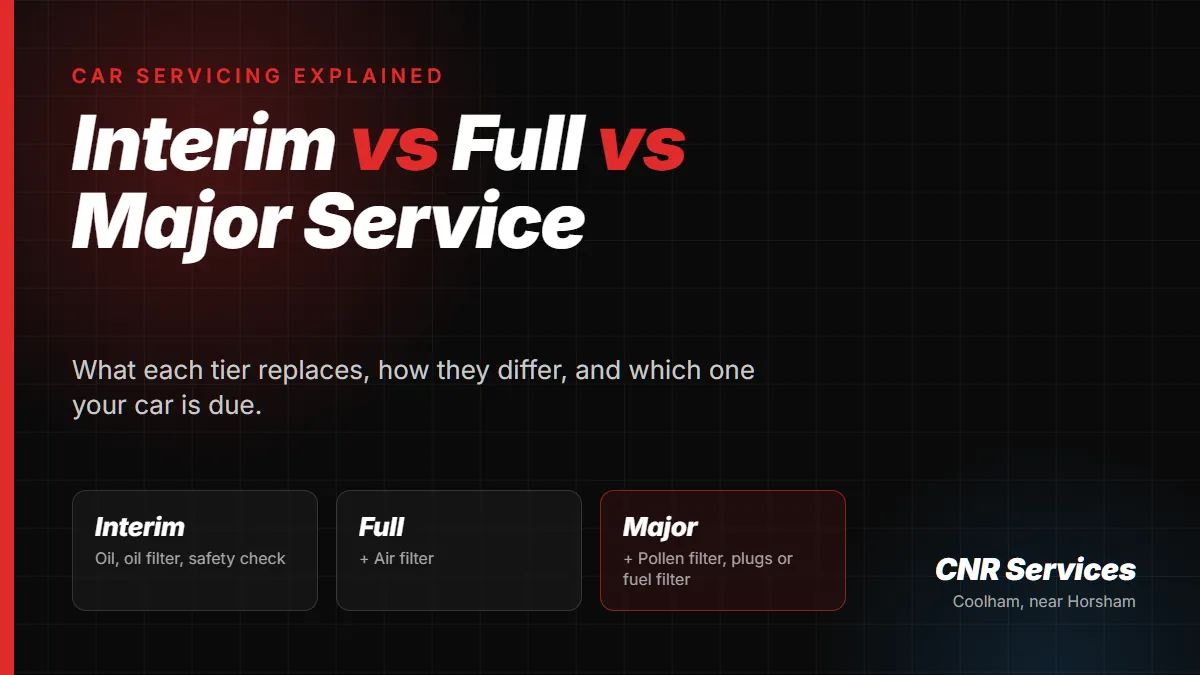
Three names, one job: keeping the car in good order between MOTs. An interim service, a full service and a major service each replace a different set of parts, and the right one depends on the car's mileage, its age and what the manufacturer's schedule says is due. Here is what each tier includes, where they differ, and how to tell which one your car needs.
What is an interim service?
An interim service is the lightest tier of routine maintenance: an engine oil change, a new oil filter and a visual safety check. It suits cars covering high mileage between annual services, and lower-mileage cars whose other filters are not yet due.
Engine oil is the item that wears out fastest. It thins with heat, picks up combustion by-products and loses its additives over time, which is why an oil and filter change sits at the bottom of every tier. An interim does not replace the air, pollen or fuel filters and does not touch the spark plugs; those wait for the next full or major visit. At CNR Services an interim service starts from £189.
What is a full car service?
A full car service is the standard annual service for most cars. It includes everything in an interim service (oil, oil filter and safety check) and adds an air filter replacement. Most manufacturer schedules expect it once a year or at a set mileage, whichever arrives first.
The air filter is what separates it from an interim. It stops dust and grit reaching the engine, and as it clogs the engine breathes less freely and fuel economy falls. The visual check covers the items that wear gradually: brakes, tyres, exhaust, suspension, lights and fluid levels. Anything found is explained and quoted before any further work goes ahead. A full service at CNR Services starts from £249 and is our most popular tier.
What is a major service?
A major service is the most thorough tier. It covers everything in a full service, then adds the longer-interval items: a pollen (cabin) filter, and either spark plugs on a petrol engine or a fuel filter on a diesel. It is due at the longer intervals in the manufacturer's schedule.
Those parts are not annual items on most schedules, which is why they have their own tier. Each has a distinct symptom when left too long:
- Spark plugs (petrol). Worn plugs cause misfires, harder starting and higher fuel consumption.
- Fuel filter (diesel). A blocked filter starves the injection system, felt as lost power under load and, eventually, trouble starting.
- Pollen filter. A clogged filter restricts airflow into the cabin, so windows take longer to demist and the vents can smell musty.
A major service at CNR Services starts from £399.
What is the difference between an interim and a full service?
The air filter and the interval. An interim service changes the engine oil and oil filter and checks the car over; a full service does the same and replaces the air filter as well. A full service is the annual service on most schedules; an interim is the lighter visit between them.
If the annual service is due, it is a full service. If the car has already had its full service within the schedule and has covered a lot of miles since, an interim keeps the oil fresh until the next one. An interim is recorded as an interim, so it does not stand in for the annual service in the car's history: a car that only ever has interims ends up on an air filter that has never been changed.
What is the difference between a full and a major service?
The longer-interval parts. A full service replaces the oil, oil filter and air filter; a major service replaces those plus the pollen filter and either the spark plugs (petrol) or the fuel filter (diesel). A major is due when the schedule calls for those items, which is less often than once a year on most schedules.
The price gap is parts and labour, not a different standard of work. Spark plugs on many modern engines sit beneath the ignition coils, and on some beneath the intake manifold, so reaching them takes longer than opening an air box, and a diesel fuel filter has to be primed after fitting. That is why the step from full to major is wider than the step from interim to full.
It is also why every tier is priced "from". A large diesel takes more oil, to a higher specification, than a small petrol engine, and a six-cylinder engine needs six plugs where a four-cylinder needs four. The tier sets what is replaced; the car sets what those parts cost.
How do interim, full and major services compare?
Each tier contains the one below it. All three change the engine oil and oil filter and include a visual safety check; a full service adds the air filter; a major service adds the pollen filter and either spark plugs or a fuel filter. The table sets the three side by side.
| Item | Interim service | Full service | Major service |
|---|---|---|---|
| Engine oil change | Yes | Yes | Yes |
| Oil filter | Yes | Yes | Yes |
| Visual safety check | Yes | Yes | Yes |
| Air filter | No | Yes | Yes |
| Pollen (cabin) filter | No | No | Yes |
| Spark plugs (petrol) or fuel filter (diesel) | No | No | Yes |
| Typical use | Between annual services, or lower-mileage cars | The annual service on most schedules | Longer-interval items due, higher-mileage cars |
| CNR Services price | From £189 | From £249 | From £399 |
How often should I service my car?
As often as the manufacturer's schedule says. Every schedule sets a time limit and a mileage limit, whichever arrives first, and the figures differ by make, engine and whether the car runs a fixed or a variable interval. The service book, the handbook or the car's own service indicator has the answer for your car.
The two limits exist because a car wears in two ways. Mileage wears the moving parts and contaminates the oil. Time works on everything else: oil oxidises whether or not the car is driven, brake fluid absorbs moisture, hoses and belts harden, and batteries age. A car that covers 3,000 miles a year still reaches the time limit every year.
Short trips are harder on oil than motorway miles. On a run to the shops the engine rarely reaches full working temperature, so moisture and unburnt fuel that would normally evaporate stay in the oil, and a low-mileage car used for short journeys can need its oil changed sooner than the mileage suggests. Some manufacturers run variable or long-life schedules, where the car's own computer sets the interval from how it has been driven; on those cars the service indicator is the schedule, and it should be reset only once the service it is asking for has been done.
Which service does your car need?
Match the tier to what the schedule says is due, then adjust for how the car is used. Annual service due: book a full. High mileage between annual services: add an interim in between. Longer-interval items due, or no record of them: book a major.
Three checks settle it for most cars:
- Read the last entry in the service book or the last invoice. If the plugs, fuel filter or pollen filter have not been done within the schedule's interval, the next service is a major.
- If the history is missing, treat the car as due everything. A car bought without a service record is best given a major so there is a known starting point.
- Keep to the schedule if the car is under warranty. An independent garage can service a car without affecting the manufacturer's warranty, provided the work follows the schedule and uses parts of original-equipment quality. The tier is set by the schedule, not the garage.
If you are not sure which applies, tell us the registration and mileage and we will say which tier the car is due. You can book an interim, full or major service online, or call us on 01403 800720. Our car servicing in Coolham, near Horsham page lists what each tier includes.
Frequently asked questions
Does an interim service count as a full service?
No. An interim service replaces the engine oil and oil filter and includes a visual safety check, but it does not replace the air filter, so it does not cover what a full service is expected to, and it is recorded in the service history as an interim. If the annual service is due, the car needs a full service.
Why does a major service cost more than a full service?
Because it replaces more parts, and the extra parts take longer to fit. A major service adds a pollen filter and either spark plugs (petrol) or a fuel filter (diesel) to everything in a full service, and both are slower jobs than an air filter. At CNR Services a full service starts from £249 and a major from £399.
Is a car service the same as an MOT?
No. An MOT is an annual legal inspection that checks whether the car meets the minimum roadworthiness standard on the day, and nothing is replaced during the test. A service is preventative maintenance that replaces worn items before they fail, which is why a car serviced before its test tends to collect fewer advisories. Our MOT testing in Coolham page explains how the test is carried out.
Will servicing at an independent garage affect my manufacturer warranty?
No, provided the service follows the manufacturer's schedule and uses parts that meet original-equipment quality. On those terms you can choose any garage for routine servicing without affecting a manufacturer warranty. Keep the invoices, which list the parts fitted and the mileage, and make sure the service book or digital service record is updated at each visit.